Nexcess Review 2026
Nexcess Review 2026 doesn’t start with hype. It starts with a simple, uncomfortable truth most people don’t realize how much their hosting is costing them until something goes wrong. Not when everything is running fine.
Not when traffic is low. But the moment your site slows down, crashes during a campaign, or starts losing conversions for reasons you can’t quite pinpoint, that’s when hosting stops being a background decision and becomes the problem.
I’ve seen it happen more times than I can count. One situation still sticks with me. A WooCommerce store owner reached out after a product launch went sideways.
Traffic wasn’t even massive just a few hundred users at once but the site couldn’t handle it. Pages stalled, checkout lagged, and customers dropped off.
It wasn’t a marketing issue. It wasn’t the product. It was the hosting. We moved that exact same store to Nexcess within a day, and the difference wasn’t subtle.
Everything stabilized. Same traffic, same design, same offers but this time, the site held up under pressure.
That’s where Nexcess positions itself in 2026. It’s not trying to win the cheapest hosting award. It’s trying to eliminate the kind of problems you don’t notice until they start costing you money.
What Nexcess Really Is in 2026
To understand Nexcess properly, you have to stop comparing it to budget hosting providers. It’s not playing in that space. Nexcess is a managed cloud hosting platform designed for performance-heavy websites, particularly those running WordPress, WooCommerce, or Magento. That means when you sign up, you’re not starting from scratch. The environment is already tuned for speed, caching is pre-configured, security layers are active, and scalability is built in.
What this translates to in real terms is less tinkering. You don’t spend hours installing plugins to fix speed issues or figuring out why your site slows down during peak hours. The infrastructure is designed to handle that before you even log in. And while that sounds like a small convenience, it compounds over time. Every hour you don’t spend troubleshooting hosting is an hour you can actually invest in growth.
But here’s the nuance and it matters. If your site is small, or if you’re still experimenting, this level of optimization might feel excessive. Nexcess isn’t about potential. It’s about demand. It shines when your website starts pushing limits, not when it’s still finding its footing.
👉 Want to explore Nexcess cloud hosting plans?

Pricing: Why It Feels Expensive (and Why That’s Not the Full Story)
Let’s address the part most people notice first—price. Nexcess is more expensive than entry-level hosting. There’s no way around that. When you see plans starting around $15 to $20 per month, especially when compared to $3 or $5 hosting deals elsewhere, it naturally raises questions.
But pricing without context is misleading. Because what you’re comparing isn’t equal.
With cheaper hosting, you’re often responsible for building your own performance stack. That means installing caching plugins, configuring CDNs, managing backups, handling security, and constantly monitoring performance. It works, but it takes time. And sometimes, even after all that effort, the results still fall short.
With Nexcess, those layers are already integrated. The system is pre-optimized, backups run automatically, and scaling happens without manual intervention. I once worked on a project where we removed five different performance plugins after moving to Nexcess. The site didn’t just stay fast it became more stable. Fewer moving parts meant fewer things breaking.
So yes, Nexcess costs more upfront. But in many cases, it reduces the hidden cost of time, maintenance, and performance issues that cheaper hosting quietly introduces.
👉 Check current pricing and features:
Performance and Speed: Where the Difference Becomes Obvious
Performance is where Nexcess separates itself from the crowd, and it doesn’t require technical analysis to notice it. You feel it. Pages load faster, dashboards respond quicker, and most importantly, the experience remains consistent even when traffic increases.
That consistency is the key detail many reviews overlook. It’s easy for hosting providers to perform well under ideal conditions. Minimal traffic, no spikes, no stress. But real websites don’t operate under ideal conditions all the time. Campaigns launch, traffic surges, users behave unpredictably—and that’s when weaknesses start to show.
Nexcess addresses this with auto-scaling. When traffic increases, the system dynamically allocates additional resources to keep your site running smoothly. There’s no need to manually upgrade your plan in the middle of a spike or worry about sudden downtime. It just adjusts.
I’ve personally seen this make a difference during affiliate campaigns. One site I worked on experienced a sudden traffic jump after a viral post. On traditional hosting, that would have been a problem. On Nexcess, the site handled it without any visible slowdown. That kind of reliability isn’t flashy—but it’s incredibly valuable.
User Experience: Power Without the Usual Complexity
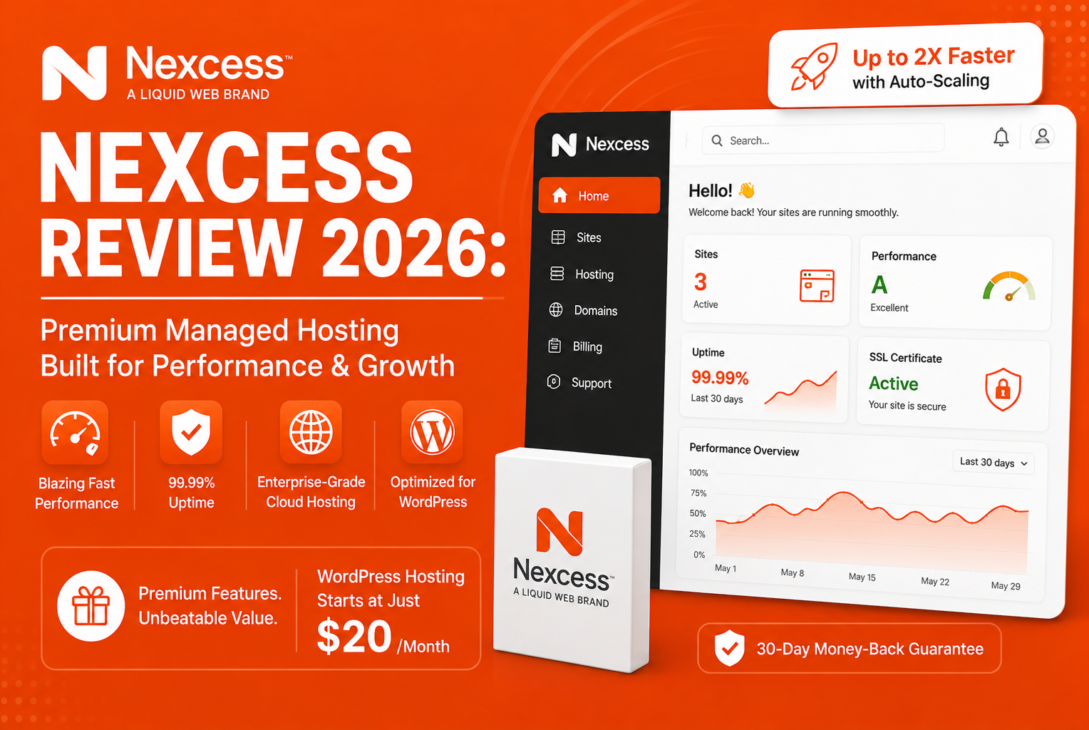
You’d expect a platform with this level of capability to feel complicated. Strangely, it doesn’t. Nexcess manages to strike a balance that’s harder to achieve than it sounds. The dashboard is clean, navigation feels logical, and most settings are accessible without digging through endless menus.
That simplicity matters more than people realize. Because when you’re under pressure—when something needs fixing quickly—you don’t want to spend time figuring out where things are. You want clarity. You want speed. And Nexcess delivers that without stripping away control.
I still remember logging into the dashboard for the first time expecting to feel overwhelmed. Instead, it felt… calm. Everything was where it should be. No unnecessary clutter. Just the tools you actually need.
👉 Ready to upgrade your hosting experience?
The Trade-Off: When Nexcess Makes Sense (and When It Doesn’t)
No hosting provider is perfect, and Nexcess is no exception. Its biggest strength performance and reliability is also what makes it feel unnecessary for certain users. If your website isn’t generating meaningful traffic or revenue yet, you might not feel the full benefit of what Nexcess offers.
That doesn’t make it a bad choice. It just means timing matters.
For businesses, eCommerce stores, and growing websites, Nexcess can feel like a natural upgrade. It removes limitations, reduces technical headaches, and creates an environment where your site can scale without constant intervention. But for hobby projects or early-stage blogs, it may feel like paying for capacity you’re not yet using.
And that’s okay.
The mistake isn’t choosing Nexcess. The mistake is choosing it at the wrong stage.
A Real-World Perspective That Changes the Conversation
In 2025, I worked with a small online store that had plateaued. Traffic was steady, but conversions weren’t improving. The assumption was that the issue lay in design or marketing. But after analyzing the site, one pattern stood out—slow load times during peak hours.
We moved the site to Nexcess.
Nothing else changed.
Within weeks, load times dropped significantly, and the user experience became smoother. Pages responded faster, checkout processes stabilized, and gradually, conversions began to improve. It wasn’t an overnight transformation, but it was consistent.
That’s what good hosting does. It doesn’t magically grow your business. It removes friction that holds it back.
👉 Need stable performance for growth?
Final Thoughts
Nexcess doesn’t try to impress with low pricing or flashy marketing. It focuses on something far less visible but far more important reliability under real-world conditions. And once you’ve experienced the difference that makes, it’s hard to go back.
Because at a certain point, your website stops being just a project. It becomes an asset. Something that generates traffic, leads, and revenue. And when that happens, the question changes.
It’s no longer about saving money on hosting.
It’s about protecting what your website is already doing and making sure it doesn’t fail when it matters most.
So the real question isn’t whether Nexcess is worth the price.
It’s whether your website has reached the point where performance is no longer optional.